
The costs of multi-family construction vary from low to high, from $120 to $600 per sq. foot, in low-rise to high-rise buildings. Multifamily investors, contractors, and builders must understand the multifamily project cost. It is a strong foundation for the successful completion of the project while staying within the budget. Underestimation may lead to risks and budget overspending, while overestimation may impact your profitable deals. An accurate and detailed breakdown of cost is exactly what drives a multifamily construction project to successful completion.
In this blog, we will discover the cost for multifamily projects for different styles, developments, and sizes for the standard US market. Let’s start
Understanding the Importance of Multifamily Cost Estimations
Calculating multi-family cost estimation is the basic foundation for a successful project. It enables developers, contractors, and construction agencies to forecast the total budget, material quantities, labor productivity, subcontractor prices, and site conditions so that they can manage all costs and allowances effectively.
Although many multifamily construction projects share similar layouts, the insights from the previous projects can also be applied to these apartments. However, they are also very different in terms of building heights, local labor rates, and material availability. Even the projects that share the same floor plans require different foundations to support the building foundations, need different finishing standards, and require different utility connections. Therefore, a proper cost estimation is essential for budget accuracy, resource allocation, and risk management. Detailed estimates help stakeholders minimize overruns and improve the financial success of each multifamily project.
From Land to Finishes: Where Every Dollar Goes for Multifamily Budgeting
Despite the hike in prices, multifamily buildings are still considered a lucrative business for investors. They invested a lot of money because it is a good day to earn a profit by renting out the apartments. However, before investment, it is essential to know how much the dollars will be spent. Three main areas need to be considered when calculating the budget of your family.
Land Cost
Land purchasing is the major factor that accounts for a huge portion of your budget for multifamily construction. According to an estimate, almost 15 to 20% of the multi-family construction budget goes for land purchasing. Location is the main factor for increasing cost. For example, land prices in dense urban areas such as Austin, Denver, or New York are very high due to the demand, while in suburban areas, or rural areas like those in Ohio and Florida, prices are lower than the national average.
Hard Cost
Hard costs include all physical construction work, for example, material prices, labor hiring, site work, structural engineering, and contractors’ and subcontractors’ prices. Hard cost predictions vary by resource, but our estimate is 50-70% or 60-80% of the total cost, depending on whether it’s a mid-rise, high-rise, or low-rise apartment rental construction.
Soft Cost
Soft costs include the budgeting required to plan, permit, finance, and design the project, which includes legal fees, permit impacts, financing fees, architectural and designers’ costs, and insurance premiums. Soft costs account for 20 to 30% of the total budget. Architectural is one of the major cost factors for soft cost, which is anywhere between 5 to 8%.
Let’s Get In Touch
Get Your Next Multi-family Construction Project’s Estimate At Discount.
Average Cost of Multi-Family Projects Due to Various Factors
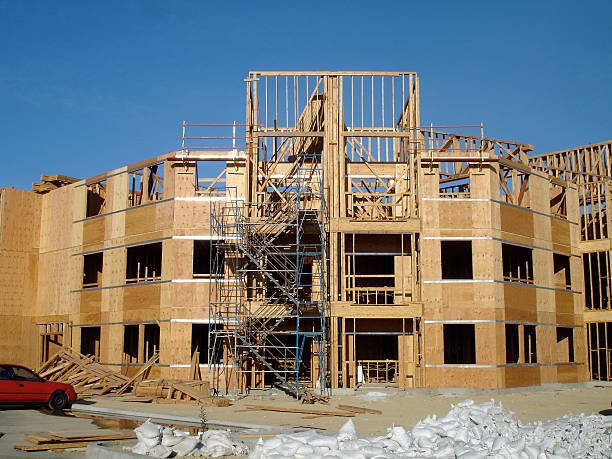
The average cost around the US is influenced by different factors such as project type, location, materials cost, etc. Understanding these variables can help to calculate the cost accurately. So let’s discuss some important factors one by one.
Cost As Per Building Type
There are three main categories: low-rise multifamily apartments, mid-rise multifamily apartments, and high-rise multifamily apartments. Let’s discuss them one by one.
Low-Rise
The average cost for low-rise buildings is $120 to $200 per square foot. These buildings usually consist of 2 to 3 stories. They are considered the most economical option due to their lower need for complex systems, such as elevators, fire protection, and emergency installations.
Mid-Rise
The cost of a mid-rise multi-apartment building varies between $180 and $300 per square foot. These buildings consist of 4-7 stories and need specialized elevators and corridors for a ventilated system. They also require an efficient MEP system and fire protection systems. Due to an increase in the number of stories, the foundation should be stronger and require more concrete and foundational material, ultimately increasing the cost of mid-rise buildings.
High Rise
The cost of high-rise buildings varies between $300 and $600 per square foot. The buildings include 8 or more stories and need more complex systems in the building for MEP installations, fire protection, structural foundation, and steel frames rather than wood frames. Such complex developments, when combined with the premium finishes, require a higher cost for high-rise buildings.
So the average construction cost for the development of all these buildings across the US is given below for one unit.
Building Type |
Cost |
| Low Rise | $150,000 – $300,000 per unit |
| Mid-Rise | $200,000 – $400,000 per unit |
| High-Rise | $350,000 – $700,000+ per unit |
Cost of Multi-Family Apartments Depending on the Class
Class B
The average cost for class B apartments varies between $150,000 and $250,000 per unit. Class B apartments are those residential buildings that offer a basic functional layout and standard finishes and have essential amenities. These are developed in suburban areas, which makes the land cost low. The overall construction cost remains low due to the affordable land cost and basic interior and exterior finishes with standard HVAC and MEP systems.
Class A
The standard cost for a class A apartment varies between $250,000 and $400,000 per Unit. These apartments require modern interior and exterior finishes with energy-efficient MEP systems and modern amenities, luxury terraces, and aesthetic balconies with structured parking. Such high finishes and amenities increase the overall cost for class A apartments.
Luxury Class
The cost of luxury apartments stands anywhere between $400,000 and $700,000+ per unit. As the name suggests, these are the top of the hierarchy of multifamily properties, and they demand modern structure, top-notch layouts, and top-notch amenities. The most expensive units in the multifamily apartment classes are these developments because of their lavish interiors, smart home technology, resort-style pools, energy-efficient MEP systems with green resources, and superior parking.
Apartment Class |
Cost Per Unit |
| Class B | $150,000 to $250,000 |
| Class A | $250,000–$400,000 |
| Luxury Class | $400,000–$700,000+ per unit |
Cost for Different Project Sizes

Project size directly impacts the overall cost. Multifamily buildings with more units require more budget to construct, while buildings with fewer units mean less area and less construction work, ultimately reducing the cost.
Unit Numbers |
Cost |
| 4 | $600,000 – $1.5M |
| 10 | $1.5M – $3.5M |
| 20 | $3M – $7M |
| 50 | $7M – $18M |
Regional Cost Difference
Construction of multifamily projects with the same project size, amenities, and class also varies from state to state. Different factors contribute to it, such as labor, permit fees, regulatory compliance, economic growth, and certain market factors for the construction industry.
For example, the construction cost for multifamily projects in California is $300 to $600 per square foot, while in Texas it ranges between $150 and $300 per square foot. The reason for Texas’s low cost is that it has more affordable labor. The permitting process is streamlined, and you don’t have to submit the fee again and again to get the approvals; there are fewer strict regulations, which make the permitting process easier on the first attempt, ultimately reducing the cost as compared to California.
Let’s Get In Touch
Get Your Next Multi-family Construction Project’s Estimate At Discount.
Factors Affecting the Cost For Multi Family Buildings
We have discussed the national average cost for different classes of apartments, height, and unit types. Besides these, some other factors can impact the final cost of apartment buildings. Let’s discuss them one by one.
Location
Location is one of the major factors that can increase or decrease the apartment building construction cost from the national average. Land prices, labor rates, procurement, transportation costs, and local permit fees all vary from state to state. According to research, the cost of multifamily building construction in California is two to three times higher than in Texas. This is because the labor cost, material costs, and regulatory phase are high in California as compared to Texas.
Amenities And Finish Level
Amenities that you want to integrate into your apartment buildings also impact the overall budget. For example, luxury features such as rooftop decks, fitness centers, pools, high-end appliances, and upgraded finishes ultimately enhance the cost of construction. At the same time, a simple apartment rental building with fewer amenities will be completed within a dedicated minimum budget. But one thing to keep in mind is that the high-finishing departmental buildings generate more rental income.
Design Complexity
A simple apartment with standard floor plans and layout is easy to build in a lower budget compared to the architecturally complex layouts with unusual angles and custom detailing. Complex customized designs increase the cost of labor due to the need for higher expertise requirements, and also increase the material purchasing cost due to the purchase of premium materials.
Construction Timeline
Usually, the construction timelines for the apartment rental buildings span months or even years due to many on-site tasks. A long construction timeline leads to more price escalations, a continuous high inflation rate, and rising labor costs due to increasing wages, which leads to cost overruns as compared to the dedicated budget.
Parking Requirement
As multifamily buildings are designed for many residents, a large space for parking is also required. While setting its own basic structure on the ground floor or underground, in both cases, the cost increases. Usually, the parking requirements are zoning-based. Besides this, soil quality, grading needs, and access to utilities also affect the cost of parking.
Apartment Costs Over the Years in the US
The cost of multifamily construction projects has rapidly grown over the years due to the high interest rates. From 2020 through 2026, the US construction industry navigated volatile cycles of labor shortages, spiking material prices, and supply chain disruptions. In 2020, due to the COVID-19 pandemic, the construction industry slowed down. As the post-COVID era started and lockdowns lifted, due to the high demand in 2021 and 2022, the prices in the construction industry have gone very high.
In 2023, prices stagnated, but labor shortages persisted across the industry. The high inflation rate, the presence of strict building codes, and the availability of skilled labor were some of the factors that contributed to the cost of multifamily construction in 2024 and 2025. With demand and high costs, multifamily construction remains one of the more expensive types of construction in 2026.
Three Main Reasons for Price Hikes Over the Years
The three main reasons for price hikes in the US for multifamily construction are given below.
Regulatory Compliance
Research by the National Association of Home Builders (NAHB) and the National Multifamily Housing Council (NMHC) revealed that, on average, regulations imposed by federal, state, and local governments consumes 32.1% of the total multifamily development costs. It can increase upto 42.6% in some cases.
These costs are proven by surveys and evident in every aspect of a project, including zoning approval, environmental and market impact studies, building code compliance, permit fees, and utility hook-up fees, and are in addition to land, hard, and soft costs.
Increase in prices of building materials
The rising prices of materials in recent years have been due to tariffs, the disruption of the supply chain, and the fluctuations of commodity prices. Industry forecasts in the last couple of years have ranged from about 4% to 9% for price increases of construction materials on a year-over-year basis, depending on the constituents of the materials and the percentage of a project that utilizes steel, aluminum, or lumber. The price of structural steel, in particular, has been affected badly – steel prices increased by almost 12% in 2025 alone, while aluminum mill shapes saw a rise of more than 30%.
Tariffs on Imported Materials
Tariffs on imported steel, aluminum, lumber, and other building components are a major contributor to the materials cost increases. The NAHB estimates that roughly 46% of U.S. construction materials are sourced from China, Canada, and Mexico, all of which have been affected by recent tariff policy. Section 232 tariffs on steel and aluminum have reached as high as 50% on certain product categories, and industry analysts estimate longer-term tariff impacts could add 5% to 25% to the increase in costs in the coming years, depending on material type.
Consequences of Not Having Proper Estimates for Multifamily Projects
Inaccurate estimates have serious financial and operational consequences for the contractors and the construction projects. When you proceed with the wrong budgeting and an inexperienced team for multi-family residential estimating services, it may lead to overspending or a shortage of materials. The effect of the procurement process, labor planning, financing approvals, equipment scheduling, and the requirement for more change orders leads to the need for corrections of errors and additional spending on-site. Poor estimates also affect the project quality and the contractor’s reputation in the market.
Do You Need Estimates For Multifamily Construction?
If you are planning to proceed with a project-specific cost estimator for your next multifamily residential project and need better financial planning and improved decision-making, then accurate budget calculations that align with your quality expectations are essential before the actual work starts on the site.
Various software for estimations are available in the market, for which you must have the skill to use them in the right way to calculate an accurate budget. If you are planning to get connected with a professional team, then Smart Constructs estimators are here to help you. You can discuss your project with us at any time.
Frequently Asked Questions
What is the proportion of soft costs vs hard costs for multifamily projects?
Soft costs account for 20-30%, while hard costs account for 70-80%
How much of the construction cost for multifamily projects accounts for code compliance?
Approximately 32% of the total cost for multifamily construction projects goes towards code compliance, such as permitting and inspection fees.
What type of costs are included in hard costs?
Interior and exterior finishes, MEP installation, site work, and utilities are included in the hard cost.
What is a possible way to optimize costs for multifamily projects?
Starting your projects with well-planned and structured estimated calculations is the most authentic way to optimize the cost.
